📬 Longseller Newsletter
Daily insights into books that sell for 10+ years.
Free · Unsubscribe anytime
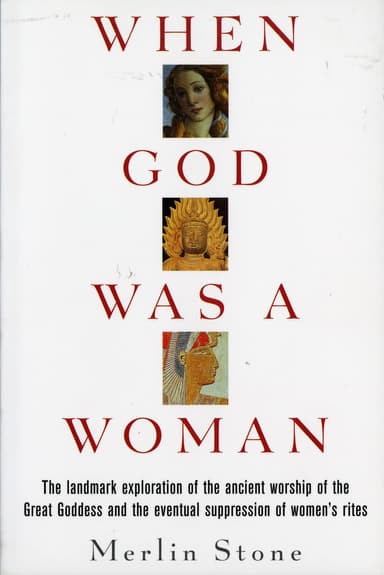
This book presents a historical argument for the widespread, ancient worship of a supreme Goddess. It documents how patriarchal Indo-European cultures systematically suppressed these matriarchal religions, replacing the divine feminine with male deities. Stone links this theological shift directly to the historical subjugation of women.
Published during the height of second-wave feminism, the book met a potent demand for a non-patriarchal spiritual and historical narrative. It offered a 'lost history' of female divinity, providing an intellectual and spiritual anchor for feminist critiques of Judeo-Christian traditions. Unlike purely theoretical feminist works of the era, it presented a compelling, evidence-based counternarrative that felt both revolutionary and ancient, resonating deeply across the Anglosphere.
So why did it keep selling?
The structural factor that keeps this book selling appears to be its function as a self-contained 'Origin Story Engine' for alternative spiritualities. It provides a complete, portable narrative—a lost golden age, a fall from grace, and a path to recovery—that requires no external institution for validation. Differentiated from dry academic texts by its passion and from later spiritual books by its scholarly presentation, it serves as a crucial entry point. This structure proves resilient to era shifts because it addresses a timeless need for a non-patriarchal source of spiritual authority, making it perpetually relevant to new generations questioning established religious frameworks.
From this analysis we name this element the Origin Story Engine. It is a narrative framework that provides a complete, emotionally resonant account of a group's or idea's past. This structure typically includes three phases: a revered beginning (a golden age), a catastrophic disruption (the fall), and the present-day struggle, which is reframed as an act of recovery or restoration. This gives profound meaning to current challenges.
The engine works by positioning the present not as a default state but as a deviation from a more authentic past. The book presents widespread Goddess worship as the original, natural state and the rise of patriarchy as a violent, imposed aberration. This reframing energizes a movement by providing a clear antagonist (the disruption) and a clear, noble goal (restoration). It generates a powerful sense of historical legitimacy and moral purpose.
We may consider applying this by examining the core narrative of a project or business. Is it merely a list of features, or is it part of a larger story of recovery? A new technology, for instance, could be framed not just as an innovation, but as a restoration of a more natural way of communicating that was lost to a previous, flawed medium. This approach creates a more powerful 'why' that attracts adherents, not just customers.
From this analysis we name this element a Portable Canon. This refers to a single text or a small set of core ideas that functions as a complete ideological or spiritual toolkit. It contains all the necessary components—history, ethics, key figures, and a central conflict—for an individual or a decentralized group to build a worldview. Crucially, it does not require a formal institution to be understood and practiced.
"When God Was a Woman" appears to operate as such a canon. It offers the historical evidence (archaeological findings), the sacred texts (reinterpreted myths), the saints and martyrs (the suppressed Goddess worshippers), and the central heresy (patriarchal religion). A reader can absorb this one book and possess a coherent, alternative spiritual system. This portability allowed the ideas to spread rapidly through informal networks across the US, UK, and Canada, bypassing established religious and academic institutions.
In a business context or when building a movement, this pattern suggests designing a message that is self-explaining and self-propagating. Rather than relying on a large sales team or complex onboarding, one could create a 'manifesto' or a core guiding document that contains the entire philosophy. Open-source software projects with excellent documentation and a clear mission statement are a prime example; they create a canon that allows a decentralized community to work cohesively toward a shared goal.
From this analysis we name this element a Veneer of Rigor. This is the strategic presentation of a polemical or revolutionary idea within the familiar, authoritative format of established scholarship. It utilizes footnotes, bibliographies, archaeological references, and a serious tone not merely to support its claims, but to signal its legitimacy to an audience that respects but may be intimidated by dense academic work.
Stone's work, while its conclusions are contested by many mainstream historians, is filled with citations and references to scholarly sources. This structure seems to provide readers with intellectual 'permission' to accept its radical conclusions, making it feel more substantial than a purely speculative text. This dual nature—the passion of a manifesto with the apparent weight of a dissertation—is a key mechanism in its cross-market appeal, attracting both spiritual seekers and intellectually curious readers.
Any project seeking to introduce a disruptive idea might apply this element. When launching a new methodology, for example, one could package it with case studies, data, and white papers that mimic the structure of impartial analysis. This provides potential adopters with the social and intellectual proof they need to justify their buy-in to others and to themselves. It is not about deception, but about translating a radical vision into a language of evidence and authority that the target audience understands and trusts.